

Boston Terrier: Breed Profile, Size, Temperament & Colors
The Boston Terrier is a compact, short-coated American breed that weighs 12 to 25 lb (5.4 to 11.3 kg) and usually lives 11 to 13 years. It is friendly, playful and very people-focused, and it adapts well to apartments and family homes. Its flat face is the main thing to plan for: Bostons overheat easily and need gentle exercise in warm weather.
Only the lightest Bostons stay under 15 lb (6.8 kg), so this breed sits at the top end of the small dogs we cover. If you want a smaller dog with a similar look and personality, compare it with the Pug or browse our tiny breeds directory.
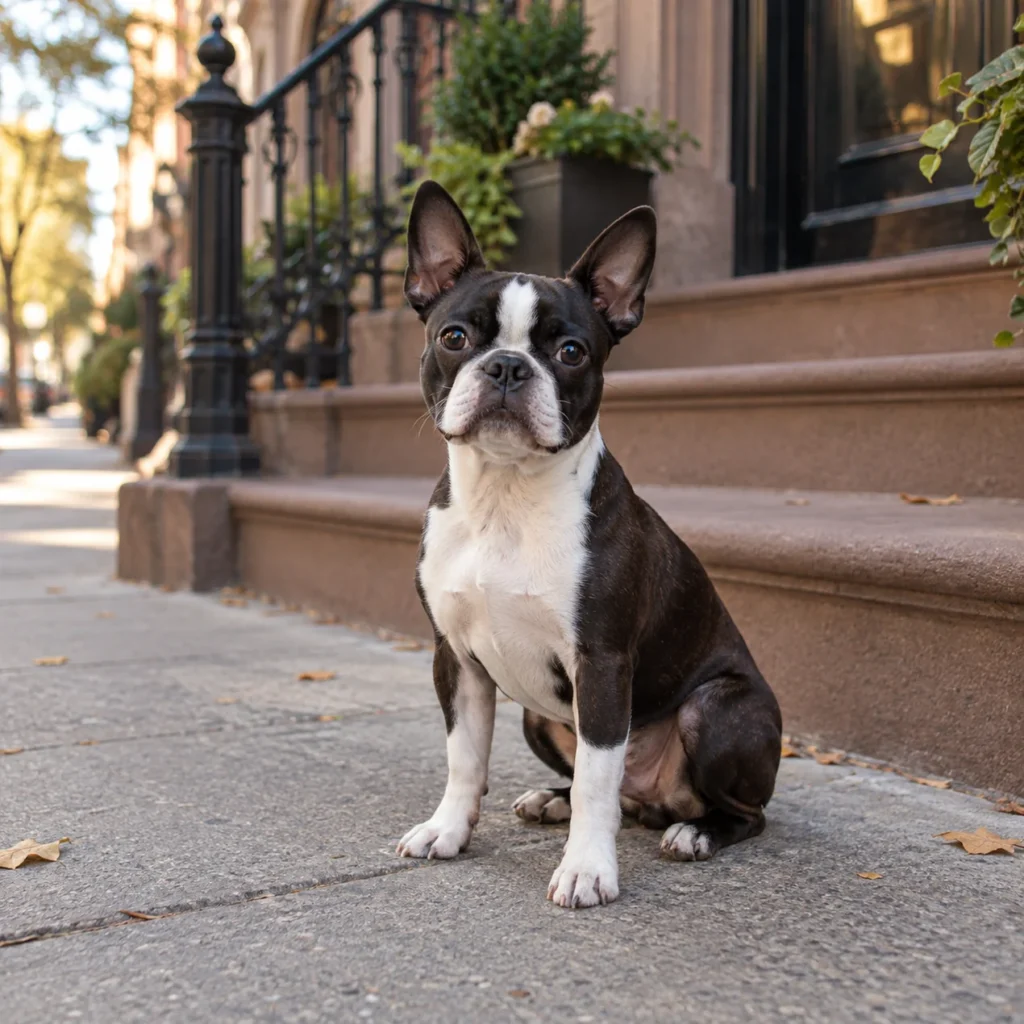
Boston Terrier Quick Facts
| Fact | Boston Terrier |
|---|---|
| Weight | 12 to 25 lb (5.4 to 11.3 kg) |
| Height | about 15 to 17 inches (38 to 43 cm) at the shoulder |
| Lifespan | 11 to 13 years |
| Coat | short and smooth, sheds year-round, weekly brushing |
| Colors | black, brindle or seal, always with white markings |
| Exercise | around an hour a day, split into walks and play, out of the heat |
| Temperament | friendly, lively, affectionate, can be stubborn |
| Good with | children and other pets when well socialized |
| Breed group | Non-Sporting (AKC, CKC), Utility (Royal Kennel Club, UK) |
| Main health watch-outs | breathing problems, eye injuries, kneecaps, spine (hemivertebrae) |
What a Boston Terrier Is Like
Bostons are nicknamed the “American Gentleman” for their neat black-and-white tuxedo markings, but day to day they are clowns more than gentlemen. Most are outgoing, quick to make friends and happiest when they are part of whatever their people are doing.
They are sturdy rather than delicate, with a square, muscular body, a short muzzle, large round eyes and upright ears. That build makes them a good choice for owners who want a small dog that can handle play with older children, but the short muzzle also limits how hard they can exercise, especially in warm weather.
Where the Boston Terrier Comes From
The breed was developed in Boston, Massachusetts, in the late 1800s from a cross between an English Bulldog and the now-extinct white English terrier. Early dogs were larger, and breeders gradually brought the size down. The American Kennel Club recognized the Boston Terrier in 1893, making it one of the first breeds developed in the United States.
Boston Terrier Size and Weight
An adult Boston Terrier weighs 12 to 25 lb (5.4 to 11.3 kg) and stands about 15 to 17 inches (38 to 43 cm) at the shoulder. Breed standards split Bostons into three weight classes, so two healthy adults can look quite different in size:
| Weight class | Weight |
|---|---|
| Lightweight | under 15 lb (under 6.8 kg) |
| Middleweight | 15 to under 20 lb (6.8 to 9.1 kg) |
| Heavyweight | 20 to 25 lb (9.1 to 11.3 kg) |
The best guide to a puppy’s adult size is the size of both parents, so ask to see them or their weights. A good breeder or rescue can tell you which class a dog is likely to fall into.
Mini and teacup Bostons: there is no recognized miniature or teacup Boston Terrier. The lightweight class is the smallest size the breed comes in. Puppies sold as “teacup” or “micro” are usually underfed runts, mixes or simply small dogs at a big markup, and very small dogs can have more health problems. Treat these labels as a warning sign.
Boston Terrier Colors, Markings and Tail Types
Standard Colors and Markings
The breed standard accepts three colors, each with white markings:
- Black and white: a true black coat with white trim.
- Brindle and white: dark tiger-stripe layering over a lighter base.
- Seal and white: looks black indoors but shows a reddish tint in bright sunlight.
The classic tuxedo pattern has a white band around the muzzle, a white blaze between the eyes and a white chest. Some Bostons also have a white collar and white on the legs. The Royal Kennel Club in the UK lists mahogany brindle and seal brindle as standard variations too.
Blue, Red, Lilac and Merle Bostons
You will see Bostons advertised as blue, red, brown, lilac or merle, often at a higher price. These colors are outside the breed standard. Brown (liver) and gray coats are disqualifying faults in the United Kennel Club standard, and the Royal Kennel Club does not register merle Boston Terriers at all. Merle is not a traditional Boston color, and breeding two merle dogs together raises the risk of puppies born blind or deaf.
A non-standard color does not make a pet Boston a bad dog, and many end up in rescue. But a seller who charges extra for a “rare” color is selling the color, not health. Ask for health test results first.
Tail Types
Boston Terriers are born with a naturally short tail. It is either straight or a screw tail, which is short and tightly curled. Tails are not docked, and a docked tail is a disqualification in the breed standard.
The screw tail is linked to hemivertebrae, misshapen bones in the spine. Many affected dogs show no signs, but some develop back pain or weak, wobbly hind legs, usually while they are still growing. See your vet if you notice either.
Boston Terrier Temperament, Family Life and Apartment Living
Boston Terriers are friendly, lively and affectionate. Most love people, greet visitors like old friends and want to stay close to their family. Many communicate with snorts, grunts and little “talking” noises rather than a lot of barking.
They usually get on well with respectful children and with other pets when they are socialized early. Their sturdy build copes better with family life than a very fragile toy breed, but always supervise young children and teach them to let the dog rest.
- Apartment life: Bostons do well in apartments or houses and do not need a yard, as long as they get daily walks and play.
- Time alone: most Bostons do not cope well with long hours alone. They suit homes where someone is around for much of the day, or where a dog walker or daycare can break up the day.
- Energy: playful bursts of energy, then long naps. They are not built for long runs or hikes.
- Stubborn streak: they learn quickly but can ignore cues they find boring. Short, fun training works best.

Still deciding if a Boston is right for you? Compare its size, coat and energy with other small companions in our tiny breeds directory.
Boston Terrier Health and Lifespan
Most Boston Terriers live 11 to 13 years. Their flat face, large eyes and screw tail come with known health risks, so it pays to know the signs and to choose a dog from health-tested parents.
- Breathing (brachycephalic airway syndrome): narrow nostrils and a long soft palate can make breathing hard work. Watch for loud breathing at rest, gagging, or tiring quickly.
- Heat: Bostons overheat faster than most dogs. Keep walks short in warm weather and never leave them in a car.
- Eyes: their prominent eyes are easy to scratch. Corneal ulcers, dry eye and cherry eye are common in the breed. A squinting, red or cloudy eye needs a vet the same day.
- Kneecaps (patellar luxation): a kneecap that slips out of place, often seen as skipping on a back leg.
- Spine (hemivertebrae): see Tail Types above.
- Other conditions: deafness, inherited juvenile cataracts, skin allergies and heart valve disease in older dogs.
Ask a breeder for proof of these tests on both parents. In the US: an eye exam by a board-certified veterinary ophthalmologist, a hearing (BAER) test, a kneecap check and the DNA test for juvenile cataracts (HSF4). In the UK: an eye test under the BVA/KC/ISDS Eye Scheme, the HSF4 DNA test and, ideally, a breathing grade under the Respiratory Function Grading Scheme.
See your vet if your dog has trouble breathing, collapses, has a painful eye or shows weakness in the back legs. For a fuller guide, read how long Boston Terriers live.
Training, Potty Training and Socialization
Bostons are quick learners who respond best to treats, praise and play. Harsh corrections tend to make them shut down or dig in their heels. Keep sessions to a few minutes, end on a success, and make sure everyone at home uses the same words and rules.
Training Basics
- Sit: hold a treat just above the nose and move it back over the head. When the rear goes down, say “sit” and reward.
- Come: say your dog’s name and “come” in a happy voice, crouch down and reward well when they reach you. Practice on a long line before trying it off leash.
- Stay: start with one second and one step back, then build up slowly.
- Quiet: reward the moment barking stops. Daily walks and puzzle toys cut boredom barking.
Potty Training
- Take your puppy out on waking, after meals, after play and before bed.
- Use the same spot each time and reward right after your puppy goes.
- Watch for sniffing, circling or whining, and head outside straight away.
- If an accident happens, calmly take your puppy outside. Never scold. Clean the spot with an enzyme cleaner so the smell does not draw them back.
- Use a crate or small pen for short rest periods so your puppy learns to hold on, with regular breaks.
Adult Bostons need a chance to relieve themselves at least four times a day. Puppy pads can help in an apartment, but plan how you will move to outdoor toileting later.
Socialization
Calmly introduce your puppy to different people, friendly vaccinated dogs, sounds, surfaces and places during the first months, and keep going for life. Start somewhere quiet, keep each outing short and reward relaxed behavior. Ask your vet which outings are safe before vaccinations are complete. A small puppy class that uses reward-based methods is a good next step. Watch the class before you sign up.
Keep a simple log of new experiences and how your dog reacted. If fear or reactivity gets worse instead of better, speak to your vet or a qualified behaviorist early.
Harness and Leash Walking
Use a well-fitted harness instead of a collar for walks. A collar presses on the throat, which is a bad idea for a flat-faced breed. Introduce the harness indoors with treats, then start with short walks. If your dog pulls, stop and wait. Move on only when the leash goes slack.
Grooming, Shedding and Daily Care
Exercise and Heat Safety
Most adult Bostons are happy with around an hour of activity a day, split into two or three walks plus indoor play. Walk early or late in summer, carry water and stop if your dog pants hard, drools heavily or lags behind. These are early signs of overheating in a flat-faced dog. In cold or wet weather a short coat means many Bostons appreciate a dog coat.
Grooming Routine
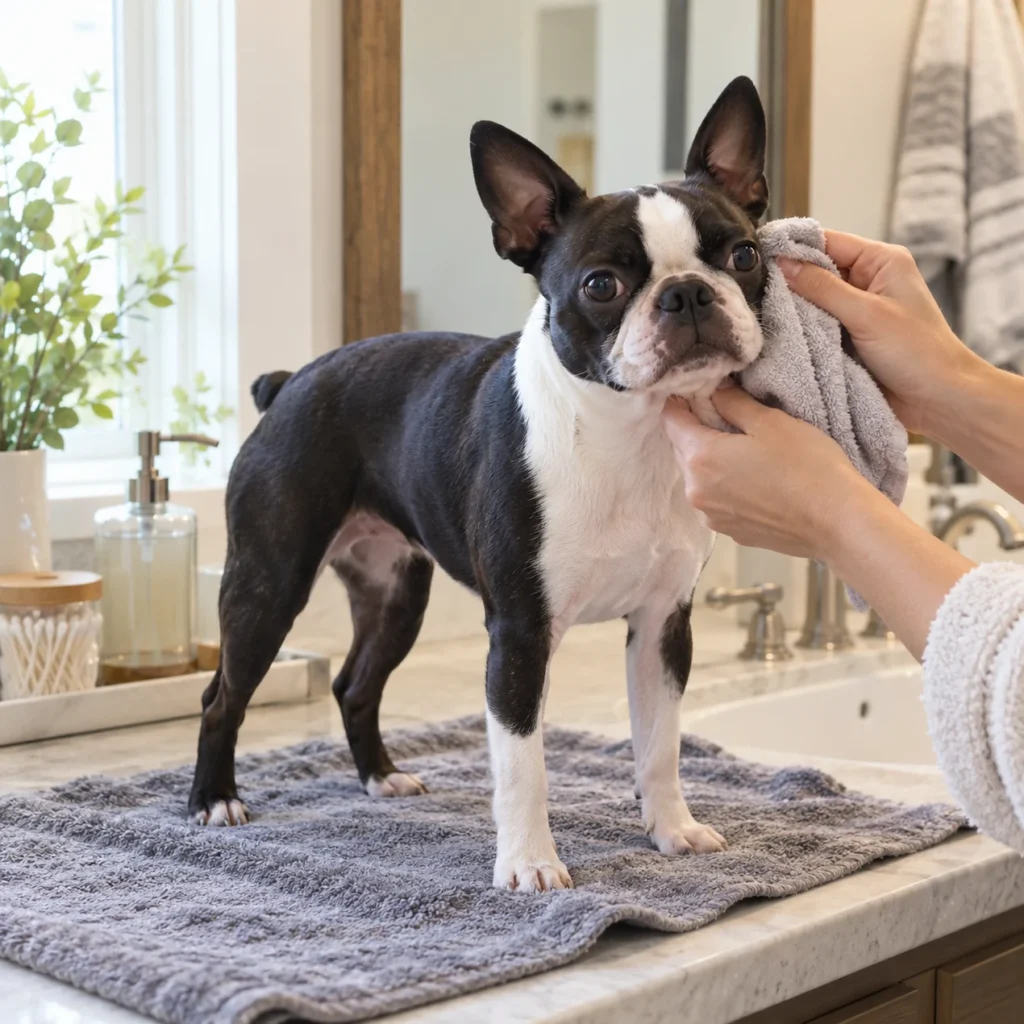
- Brushing: once a week with a soft bristle brush or rubber curry brush, working from head to tail. Brush a few times a week when shedding increases.
- Baths: every few weeks, or when dirty, with a gentle dog shampoo and lukewarm water. Bathing too often can dry out the skin.
- Face and eyes: wipe around the eyes and any facial wrinkles every day or two with a soft damp cloth, then dry well.
- Nails: trim every few weeks, taking off small amounts to avoid the quick. A grinder is a good option for nervous dogs.
- Teeth and ears: brush teeth daily if you can, and check the ears weekly for redness or smell.
Boston Terriers shed year-round. Their short coat is easy to keep under control, but they are not hypoallergenic. After each grooming session, check the skin for redness or rashes, as allergies are common in the breed.
Gear for a Boston Terrier
Tiny Loving Canines may earn a commission when you buy through links on this page. It does not change what we recommend.
- Harness: a Y-front or step-in harness that leaves the throat free, with no pressure on the windpipe.
- Face and wrinkle wipes: fragrance-free and safe for use near the eyes.
- Cooling mat and water bottle: for summer walks and warm homes.
- Pet insurance: check that cover includes breathing surgery, eye conditions and spine problems, and read the exclusions for known breed conditions.
Boston Terrier vs French Bulldog
Bostons and Frenchies are often confused, and both are flat-faced, short-coated companions. Here is how they differ:
| Boston Terrier | French Bulldog | |
|---|---|---|
| Weight | Boston 12 to 25 lb (5.4 to 11.3 kg) | Frenchie under 28 lb (12.7 kg) |
| Build | Boston leggier, lighter and more athletic | Frenchie heavier, more compact and bulldog-like |
| Ears | Boston upright and pointed | Frenchie broad, rounded “bat ears” |
| Colors | Boston always black, brindle or seal with white tuxedo markings | Frenchie brindle, fawn, white or brindle and white, with more variety |
| Energy | Boston needs moderate exercise and enjoys play | Frenchie is happy with a short daily walk |
| Origin | Boston from Boston, USA | Frenchie from England and France |
Both breeds share breathing and heat risks, so health-tested parents and a careful summer routine matter for either. At 12 to 25 lb, the Boston is usually the lighter of the two. If you want the same cheerful flat-faced look in a smaller package, read about the Pug.
Adopting or Buying a Boston Terrier
Start with rescue. Many Bostons, including adults and seniors, end up in shelters when owners are not ready for the breathing, eye or vet costs. Check your local shelters and search for Boston Terrier breed rescues in your state, province or region. Rescue staff and foster carers can tell you how a dog behaves with children, cats and time alone.
Tiny Loving Canines is not a rescue and does not rehome or sell dogs. We help you find and compare your options.
If you buy a puppy, choose a breeder who:
- Lets you meet the mother and see where the puppies are raised
- Shows health test results for both parents (eyes, hearing, kneecaps, HSF4 DNA and, in the UK, a breathing grade)
- Asks you questions, offers a written contract and will take the dog back at any age
- Does not charge extra for “rare” colors or sell “teacup” or “mini” Bostons
Walk away from sellers who ship puppies sight unseen, ask for a deposit before you visit, always have puppies ready, or will not show the parents. These are common signs of puppy mills and online puppy scams.
Ready for the next step? Read our guide to how long Boston Terriers live so you know what the years ahead look like, or compare other small companions in our tiny breeds directory.
Boston Terrier FAQ
Is a Boston Terrier a small breed?
Yes, but it sits at the top end of small. Boston Terriers weigh 12 to 25 lb (5.4 to 11.3 kg), and the Royal Kennel Club lists the breed as small. Only lightweight Bostons stay under 15 lb (6.8 kg). The AKC places the breed in the Non-Sporting Group rather than the Toy Group, so a Boston is a small dog, not a toy dog.
What are the pros and cons of a Boston Terrier?
The pros are a sturdy, compact size, a short coat that needs only weekly brushing, a friendly nature that usually suits children and other pets, and an easy fit in apartments. The cons are a flat face that limits heat and exercise tolerance, prominent eyes that injure easily, year-round shedding, a stubborn streak and a dislike of long hours alone.
Are Boston Terriers good house dogs?
Yes. Bostons are indoor companions that do well in apartments or houses. They are not built to live outdoors and need protection from heat and cold. They do not need a yard, but they do need daily walks, play and company, since most do not cope well with being left alone for long hours.
Do Boston Terriers like to cuddle?
Most do. Boston Terriers are people-focused dogs that like to stay close to their family, and many happily share the sofa or follow you from room to room. Every dog is different, and a newly adopted adult may need a few weeks to settle in. Let your dog choose when to come to you, and reward calm closeness.
What is the rarest color of a Boston Terrier?
No color is officially rarer than another. The breed standard accepts only black, brindle or seal, each with white markings. Colors sold as rare, such as blue, red, lilac, brown or merle, are outside the standard, and the Royal Kennel Club does not register merle Bostons. Treat a higher price for a “rare” color as a warning sign and ask for health tests instead.
Is it better to get a male or female Boston Terrier?
Neither is better. Differences between individual Bostons are bigger than any general difference between males and females, so choose the dog whose energy and confidence suit your home. If you adopt an adult, the rescue or foster carer can tell you how that dog behaves. Talk to your vet about the right time to spay or neuter.
Are Boston Terriers born with tails?
Yes. Boston Terriers are born with a naturally short tail, either straight or a tightly curled screw tail. Their tails are not docked, and a docked tail is a disqualification in the breed standard. The screw tail is linked to hemivertebrae, misshapen spine bones, so see your vet if your dog shows back pain or weak hind legs.
Do Boston Terriers shed, and are they hypoallergenic?
Boston Terriers shed year-round and are not hypoallergenic. Their short coat is easy to manage with a weekly brush, and a rubber curry brush lifts loose hair well. Allergens come from skin flakes and saliva as well as hair, so if someone at home has allergies, spend time with an adult Boston before you commit.
How much exercise does a Boston Terrier need?
Most adult Bostons need around an hour of activity a day, split into walks and play. Walk in the cooler parts of the day, use a harness instead of a collar, and stop if your dog pants hard or struggles to breathe, because flat-faced dogs overheat quickly. Puppies need shorter sessions and plenty of rest.
Is a Boston Terrier good for a first-time owner?
A Boston can suit a first-time owner who is home a lot and ready for short daily training. Bostons learn quickly with treats and praise but can be stubborn, and their flat face means extra care in heat and higher vet costs. Find a vet and arrange pet insurance before your dog comes home.