

Home › Breeds › Miniature Dachshund › Dachshund Lifespan and Health
Dachshund Lifespan, Size Chart, and Health Risks
The average Dachshund lifespan is 12 to 16 years, and miniature Dachshunds often reach around 14. A full-grown miniature weighs 11 lb (5 kg) or less and stands about 5 to 6 inches (13 to 15 cm) tall, while a standard weighs 16 to 32 lb (7.3 to 14.5 kg). Their long backs make intervertebral disc disease (IVDD) the main health risk, so weight control and back care matter from puppyhood.
New to the breed? Start with our Miniature Dachshund breed guide for temperament, coat types and daily care.
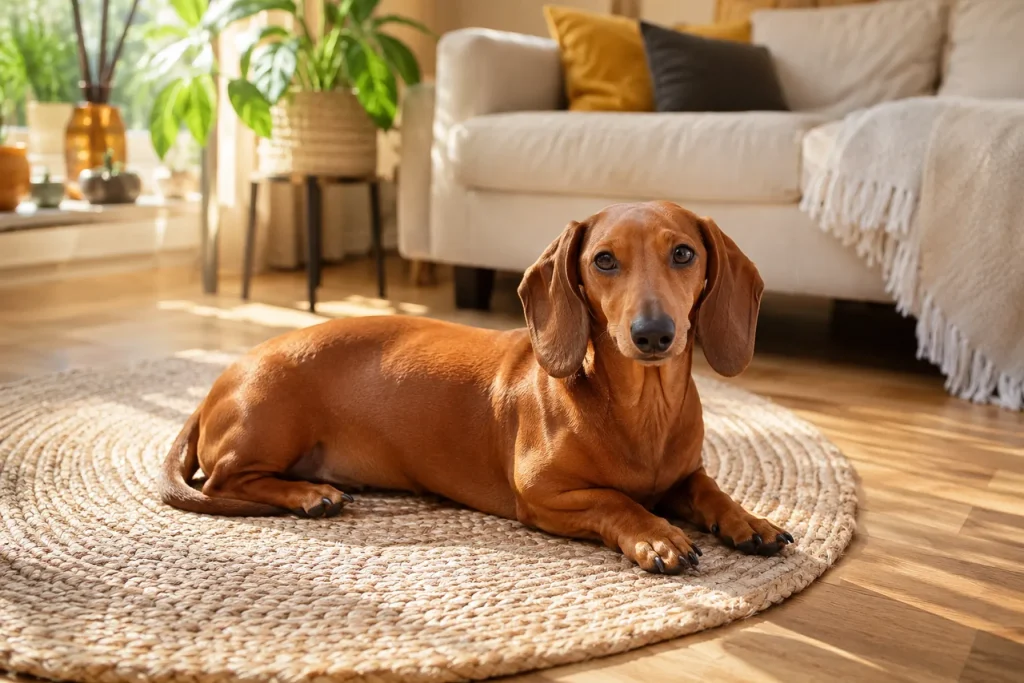
How Long Do Dachshunds Live?
Most Dachshunds live 12 to 16 years. The UK’s Royal Kennel Club lists the breed’s lifespan as over 12 years, and a 2024 study of more than 580,000 dogs in the UK put the median life expectancy of miniature Dachshunds at around 14 years.
That makes the Dachshund one of the longer-lived breeds, but the average hides one big risk. Disc problems in the spine usually start in middle age, between about 3 and 7 years, and a dog that loses the use of its legs needs treatment fast. Most of what shortens a Dachshund’s life can be prevented or treated if it is caught early.
Vets consider Dachshunds seniors from about 9 years. From then on, ask your vet how often your dog should have a check-up.
Dachshund Size Chart: Miniature vs Standard
Dachshunds come in two sizes and three coat types: smooth, long-haired and wire-haired. Coat type does not change size. Size is set by adult weight, and most Dachshunds reach adult size by about 12 months.
| Size | Adult weight | Height at the shoulder | Typical lifespan |
|---|---|---|---|
| Miniature Dachshund | 11 lb (5 kg) or less | 5 to 6 in (13 to 15 cm) | 12 to 16 years (around 14 years median in UK data) |
| Standard Dachshund | 16 to 32 lb (7.3 to 14.5 kg) | 8 to 9 in (20 to 23 cm) | 12 to 16 years |
Country differences: In the US, a miniature weighs 11 lb (5 kg) or less as an adult. The Canadian Kennel Club’s standard gives an ideal miniature weight of 10 lb (4.5 kg) and a chest girth of no more than 13.75 in (35 cm). In the UK, the Royal Kennel Club prefers miniatures under 5 kg (11 lb).
Tweenies: Dogs that end up between the two sizes are often called tweenies. This is not a separate size, and tweenies carry the same back risks as minis and standards.
Is your dog the right weight? A chart gives a range, not a target for your dog. You should be able to feel your Dachshund’s ribs under a thin layer of fat and see a waist when you look down from above. If you cannot, ask your vet for a body condition check and a target weight.
What Affects a Dachshund’s Lifespan
Genes set the starting point, but day-to-day care decides a lot. These four areas make the biggest difference.
Weight and Diet
Extra weight is the factor you control most, and it matters more in a Dachshund than in most breeds because it loads a long spine. Feed a complete diet made for small breeds, weigh portions instead of scooping, and count treats as part of the daily total. Ask your vet for a target weight and recheck it at every visit.
Exercise
Miniature Dachshunds need up to an hour of exercise a day, according to the Royal Kennel Club. Split it into steady walks, sniffing games and short training sessions. Limit high-impact play such as repeated jumping, rough wrestling and leaping off furniture, which strains the back.
Breeding and Health Testing
Back and eye problems run in families. In the UK, the Royal Kennel Club strongly recommends spine screening for IVDD before breeding, plus a DNA test for progressive retinal atrophy (PRA cord1) and eye testing. Wherever you live, ask to see health results for both parents. The Kennel Club does not register puppies from two dapple parents because of the risk to sight and hearing.
Be wary of any seller who cannot show health results, sells ’teacup’ Dachshunds that are bred to be smaller than the miniature size, or will ship a puppy you have not met. Breeding for extreme smallness and selling without checks are signs of a puppy mill.
Regular Vet Care
Routine check-ups catch weight gain, dental disease and eye changes early. Keep vaccinations and parasite prevention up to date, and ask your vet to check your dog’s back, gait and kneecaps at each visit.
IVDD in Dachshunds: What Owners Need to Know
Intervertebral disc disease (IVDD) happens when the cushioning discs between the bones of the spine swell or burst and press on the spinal cord. Dachshunds account for 45 to 70% of all disc ruptures seen by vets, and as many as 1 in 4 Dachshunds develop IVDD in their lifetime. Signs usually start between about 3 and 7 years of age.
Warning Signs of a Back Problem
- Back or neck pain: your dog refuses to walk, move around the room or be picked up
- A wobbly, ’drunken’ walk, often with the hind feet crossing
- Weak back legs, or back legs that drag
- Loss of bladder control
This can be an emergency. Some dogs go from walking normally to paralyzed in less than an hour, and dogs that lose the use of their legs ideally need surgery within 24 hours. If your Dachshund cannot walk or stand, go to an emergency vet now. Do not wait to see if it improves.
Treatment and Recovery
A mild first episode is often treated with strict crate rest and medicine prescribed by your vet. If pain or wobbliness continues after several days, or your dog cannot walk, surgery to take pressure off the spinal cord is usually recommended.
Outcomes depend on how much feeling is left in the legs. When a dog can still feel pain in its legs, about 90% regain the use of them after surgery, compared with 60 to 80% with strict rest and medicine alone. When all feeling is lost, 50 to 60% recover with surgery and fewer than 10% without. About 1 in 4 dogs have another disc problem later, so back care continues for life.
Because IVDD can mean imaging, surgery and weeks of rehab, and back problems often come back, many Dachshund owners look at pet insurance while their dog is young and healthy, before any back issue can be listed as pre-existing. When you compare policies, check how each one covers IVDD, hereditary conditions and repeat claims for the same problem.
Protecting Your Dachshund’s Back Every Day
You cannot remove the risk of IVDD, but small habits lower the strain on your dog’s spine.
- Keep your dog lean. Weight is the biggest risk you can change.
- Cut down on jumping. Put ramps or steps by the sofa and bed, and lift your dog in and out of the car.
- Restrict stairs. Use a baby gate, and carry your dog on stairs you cannot block.
- Lift with two hands. One hand under the chest and one under the hindquarters keeps the back level.
- Choose steady exercise. Daily walks and sniffing games are better than repeated jumping or rough play.
- Watch for small changes. A dog that suddenly stops jumping or climbing may be in pain. Call your vet early.
Other Common Dachshund Health Issues
Beyond back problems, these are the conditions vets see most often in Dachshunds.
- Obesity: common in the breed, and it raises the risk of disc disease and joint problems.
- Dental disease: small dogs are more prone to periodontal disease (see the next section).
- Eye conditions: cataracts, glaucoma and progressive retinal atrophy (PRA). Cloudy eyes or bumping into things need a vet check.
- Luxating patella: a kneecap that slips out of place. You may see your dog skip or hold up a back leg for a few steps.
- Hypothyroidism and Cushing’s disease (hyperadrenocorticism): hormone conditions of adult dogs that your vet can test for.
- Bladder stones: watch for straining, frequent small pees or blood in the urine.
Deafness and epilepsy also occur in the breed. If you notice anything unusual, ask your vet rather than waiting for the next routine visit.
Dental Care and Senior Dachshunds
Small dogs like Dachshunds are more prone to periodontal disease, which causes pain and tooth loss. Brushing your dog’s teeth regularly with a dog toothpaste, and having your vet check the mouth at every visit, keeps problems small. Our guide on how to groom a Dachshund covers teeth, ears and nails. Bad breath, red gums or dropping food are reasons to book a check.
From about 9 years, a Dachshund is a senior. Common problems at this age include joint disease, long-term disc disease and cataracts. Keep walks gentle and regular, keep ramps in place, and tell your vet about stiffness, a change in appetite or weight, or cloudy eyes.
When to Call a Vet
This list is a guide, not a diagnosis. If you are unsure, call your vet.
- Go to an emergency vet now: your dog cannot walk or stand, drags its back legs, loses bladder control, or is in sudden severe pain.
- Call your vet today: a wobbly walk, refusing to jump or climb, crying out when picked up, or a hunched back.
- Book a check-up: steady weight gain, bad breath or red gums, cloudy eyes, a skipping back leg, or straining to pee.
Dachshund Lifespan and Health FAQs
How long do Dachshunds live?
Most Dachshunds live 12 to 16 years. Miniatures tend to sit toward the top of that range: a 2024 UK study of more than 580,000 dogs put the median life expectancy of miniature Dachshunds at around 14 years. A lean body, a protected back, regular dental care and yearly vet checks give your dog the best chance of reaching the upper end.
Can Dachshunds live 20 years?
It is possible but very unusual. The typical Dachshund lifespan is 12 to 16 years, so a dog in its late teens is already well beyond average. Rather than aiming for a number, focus on what you can control: keep your Dachshund slim, limit jumping, look after its teeth and book regular check-ups once it becomes a senior at about 9 years.
How long do miniature Dachshunds live?
Miniature Dachshunds usually live 12 to 16 years. In a 2024 UK study of more than 580,000 dogs, miniature Dachshunds had a median life expectancy of around 14 years, which puts them among the longer-lived breeds. Their small size does not protect them from IVDD, so back care matters just as much for a mini as for a standard.
How big is a Mini Dachshund full grown?
A full-grown Miniature Dachshund weighs 11 lb (5 kg) or less and stands about 5 to 6 inches (13 to 15 cm) at the shoulder. Dogs that end up heavier than a miniature but lighter than a standard are often called tweenies. They are not a separate size, and they carry the same back risks. The Miniature Dachshund breed guide covers temperament and coat types.
Are long-haired miniature Dachshunds bigger?
No. Coat type does not change size. A long-haired miniature Dachshund is the same size as a smooth or wire-haired miniature: 11 lb (5 kg) or less and about 5 to 6 inches (13 to 15 cm) tall. The longer coat can make it look larger in photos. For brushing and bathing routines, see the Dachshund grooming guide.
When is a Dachshund full grown?
Most Dachshunds reach adult size by about 12 months, which is when vets start treating them as adults rather than puppies. After that, any steady gain on the scale is usually fat, not growth. If your young Dachshund keeps getting heavier after its first birthday, ask your vet for a body condition check, because extra weight puts more load on the spine.
What health problems are Dachshunds prone to?
The biggest risk is intervertebral disc disease (IVDD): as many as 1 in 4 Dachshunds develop it. Other common problems are obesity, dental disease, eye conditions such as cataracts and progressive retinal atrophy (PRA), luxating patella, hypothyroidism, Cushing’s disease and bladder stones. If you buy a puppy, ask the breeder for back and eye screening results for both parents.
How can I prevent back problems in my Dachshund?
You cannot remove the risk, but you can lower it. Keep your Dachshund lean, because extra weight loads the spine. Limit jumping on and off furniture, restrict access to stairs and use ramps where your dog likes to climb. Choose steady daily walks over high-impact games. Lift your dog with one hand under the chest and one under the hindquarters so the back stays level.
How do I know if my Dachshund hurt its back?
Watch for signs of back or neck pain, such as refusing to walk, move around or be picked up, a wobbly ’drunken’ walk with the hind feet crossing, weak or dragging back legs, or loss of bladder control. Any of these needs a vet the same day. If your Dachshund cannot walk or stand, treat it as an emergency and go to an emergency vet now.
A healthy Dachshund is a long-lived one. Keep your dog lean, protect its back and get changes checked early. For temperament, coat types and daily care, read our Dachshund breed guide, or compare other small dog breeds if you are still choosing.