

Best Small Dog Toys: Chewers, Fetchers, and Brain Games
The best small dog toys are too big to fit fully inside your dog’s mouth, soft enough to dent with a fingernail, and matched to the way your dog likes to play. Strong chewers need dense rubber that still bends, fetchers need light balls they can carry but not swallow, and busy minds need puzzle toys that turn part of a meal into a job. This guide shows what to look for in each type, how to spot a toy that is too hard or too worn, and how to make free toys at home.
How to Choose Safe Toys for Small Dogs
A tiny dog has a small mouth, small teeth and a narrow throat, so the safety checks matter more than the label on the box. Check every new toy against these four points before you hand it over.
Size: Too Big to Swallow, Small Enough to Carry
A chew toy should be too large to fit completely inside your dog’s mouth. Anything that disappears behind the teeth can slip to the back of the throat and cause choking. For balls, pick one your dog can pick up and carry, but never one small enough to swallow. Toy breeds such as the Chihuahua often need toys sold for extra-small dogs, but check each one against your own dog. If you are between two sizes, choose the larger one.
Hardness: The Bend and Dent Test
Press your fingernail into the toy. If it leaves a small dent, it is soft enough for most dogs. Long chews should also bend a little when you flex them between your hands. Hard items that do not bend, such as bones, antlers, cow hooves and hard nylon chews, can chip or break teeth.
Parts and Materials to Avoid
- Ribbons, plastic eyes, bells and other parts that can be chewed off and swallowed
- Scratchy, sandpaper-like surfaces, such as the felt on some tennis balls, which can wear teeth down with heavy chewing
- Toys that break into small or sharp pieces
- Cords, strings and loose threads, which a small dog can swallow
Supervise Every New Toy
Watch your dog with every new toy for the first few sessions. Take it away if your dog is tearing off chunks or biting down hard enough to strain their teeth. Keep play sessions short and offer water and a rest. If your dog swallows a piece of a toy, call your vet straight away, even if your dog seems fine.
Match the Toy to How Your Dog Plays
Most small dogs have one or two favorite ways to play. Start with toys for that style, then add one toy from another group to keep things varied.
| Play style | Signs | Good toy types | Skip |
|---|---|---|---|
| Chewer | Gnaws for long stretches, destroys plush fast | Dense rubber chews that still bend, stuffable rubber toys | Bones, antlers, hooves, hard nylon |
| Fetcher | Chases anything that rolls, brings things back | Light rubber or soft balls, small soft throw toys | Balls small enough to swallow |
| Carrier and cuddler | Carries one toy around, sleeps with it | Soft plush with stitched seams, small squeaky toys | Plush with button eyes or loose ribbons |
| Problem-solver | Sniffs everything, steals food, gets bored fast | Snuffle mats, treat balls, beginner puzzle boards | Puzzles that are too hard at the start |
| Teething puppy | Chews hands, shoes and furniture | Rubber chews that dent easily, toys you can chill | Anything very hard |
| Senior dog | Less active, may have sore teeth or joints | Easy puzzle toys, lick mats, soft plush | Hard chews, long fetch sessions |
Best Toys for Chewers and Aggressive Chewers
Some small dogs, including many terriers and Miniature Dachshunds, chew much harder than their size suggests. Chewing is normal and healthy, but the toy has to survive it without breaking into pieces or breaking teeth.
What to look for:
- Solid, dense rubber that still passes the bend and dent test
- One piece, with no seams or glued parts to chew off
- A shape your dog can hold between the front paws, such as a ring or bone sized for small dogs
- A hollow center you can stuff with food, which slows chewing and adds a reward
No toy is truly indestructible. Words like tough or extreme describe the material, not a promise. If your dog can bite pieces off a toy, that toy is not right for your dog, whatever the label says. Check chews often and throw them out before they wear thin, because worn edges break off and can be swallowed.
For a dog that destroys everything, rotate two or three tough rubber toys, give a stuffed food toy when you leave the room, and add a daily sniffing game. Destructive chewing is often a sign of boredom or too little exercise, so more activity usually helps more than a harder toy. If the chewing happens mainly when your dog is alone, talk to your vet or a qualified trainer about separation anxiety.
Best Puzzle and Enrichment Toys for Small Dogs
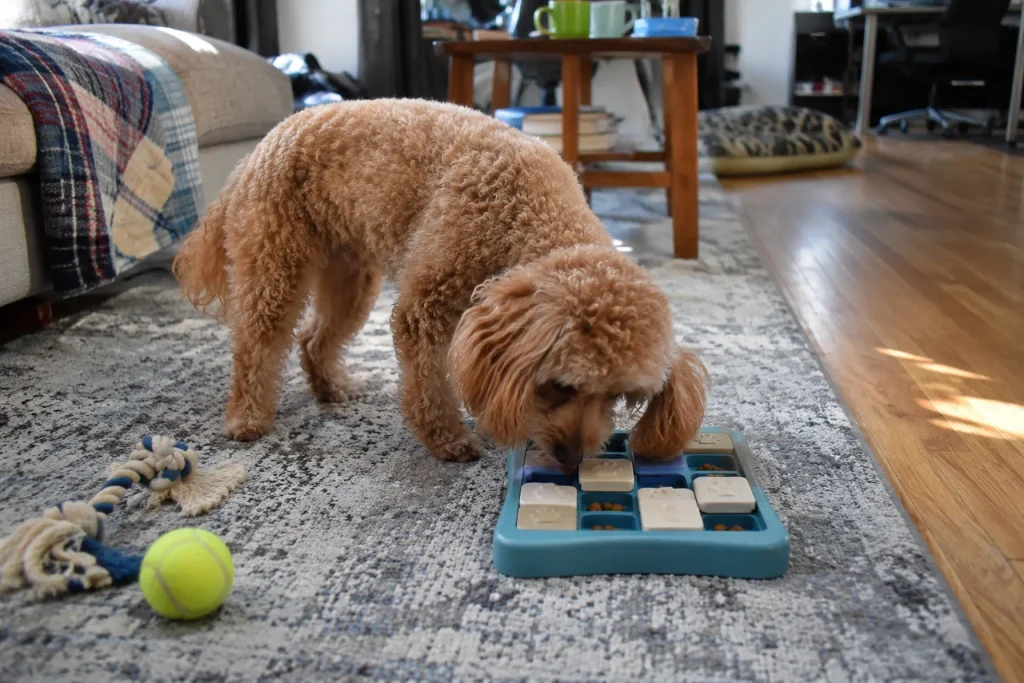
Mental work can tire a small dog out as much as a walk, and it fits into an apartment. Puzzle and food toys let your dog sniff, search and solve for food, which uses natural foraging instincts and gives a bored dog something better to do than bark or chew the furniture.
Types of Puzzle Toys
- Snuffle mats: fabric strips that hide kibble, so your dog sniffs it out. Good for beginners and for fast eaters.
- Treat balls and wobblers: your dog rolls or nudges the toy to release food. Match the treat size to the hole: too small and it all falls out, too big and it gets stuck.
- Stuffable rubber toys: fill with soft food, then freeze for a longer challenge.
- Lick mats: a textured mat you spread with soft food. Calming, and gentle on older teeth.
- Puzzle boards: sliding lids, flaps or cups your dog moves with nose or paws. Start with the easiest level.
How to Make Puzzles Harder, Step by Step
- Start easy. Spread a little soft food on the surface, or use a toy with large holes, so your dog wins in the first minute.
- Next, use smaller holes or fewer openings, or a thin layer of soft food with kibble pressed in.
- Then fully stuff the toy and freeze it.
- Stop before frustration. If your dog walks away or starts chewing the toy in anger, go back one step.
You can feed part of your dog’s daily food from a puzzle toy instead of a bowl. Take it from the normal daily amount so a tiny dog does not gain weight, and ask your vet how much your dog should eat each day. Puzzles also help older dogs: senior dogs that solve food puzzles regularly show better cognitive health.
If you have more than one dog, give food toys in separate rooms. Some dogs guard a toy that holds food, even from a dog they normally get on with.
Every small breed plays a little differently. Some were bred to hunt and dig, others to keep people company. Look up your dog in our small dog breed directory to see how much activity and mental work the breed needs.
Best Fetch Toys for Tiny Dogs
Fetch is an easy way to exercise a small dog indoors or in a small yard. Start with a soft toy or a light ball, throw it a short distance, and reward your dog every time it comes back. Tiny dogs tire quickly, so keep sessions short and stop while your dog still wants more.
What to look for:
- A ball your dog can carry comfortably, but too big to swallow or get stuck in the throat
- Light, soft rubber or fabric, so a missed catch does not hurt teeth or eyes
- A bright color you can find under the sofa
- A low bounce for indoor play on hard floors
Are Tennis Balls Safe for Small Dogs?
Standard tennis balls are too big for many toy breeds to carry, and the felt is abrasive. With heavy chewing it can wear down teeth. A mini ball made for dogs, or a smooth rubber ball that is too big to swallow, is a better choice. Use fetch balls for fetch, then put them away instead of leaving them out as chew toys.
Ball Launchers
A launcher can work for a small dog if you can set a short throw distance and use balls in the right size. Keep sessions short, especially for flat-faced breeds, long-backed dogs such as Dachshunds, and any dog with joint problems, and skip fetch on hot days.
Toys for Small Puppies and Teething
Most puppies start growing adult teeth by about 4 months of age, and the back teeth come through between about 4 and 7 months. Puppies chew to ease sore gums, so the right toys protect both their new teeth and your furniture.
- Choose rubber toys that bend and dent easily. New adult teeth can break on nylon, bones or antlers.
- Chill a rubber toy in the freezer to soothe sore gums.
- Keep several approved chews within reach and praise your puppy for using them.
- Remove any toy that is breaking apart or missing pieces. Swallowed pieces can block the gut or get stuck in the throat.
- Do not let your puppy chew hands or feet in play, even when it is cute.
A little blood on a toy during teething is common, and swallowing baby teeth is normal. Call your vet if anything worries you.
Free DIY Toys and Indoor Games for Small Dogs
You do not need to spend money to keep a small dog busy. These toys and games use things you already have at home. Stay with your dog for any game that uses cardboard, fabric or plastic, and pick up the pieces before your dog eats them.
Muffin Tin Game
Put a treat in each cup of a muffin tin and cover each cup with a ball. Your dog lifts the balls to find the food. Later, put treats in only some cups so your dog has to use its nose. For toy breeds, use a mini muffin tin and balls that are still too big to swallow.
Box Search
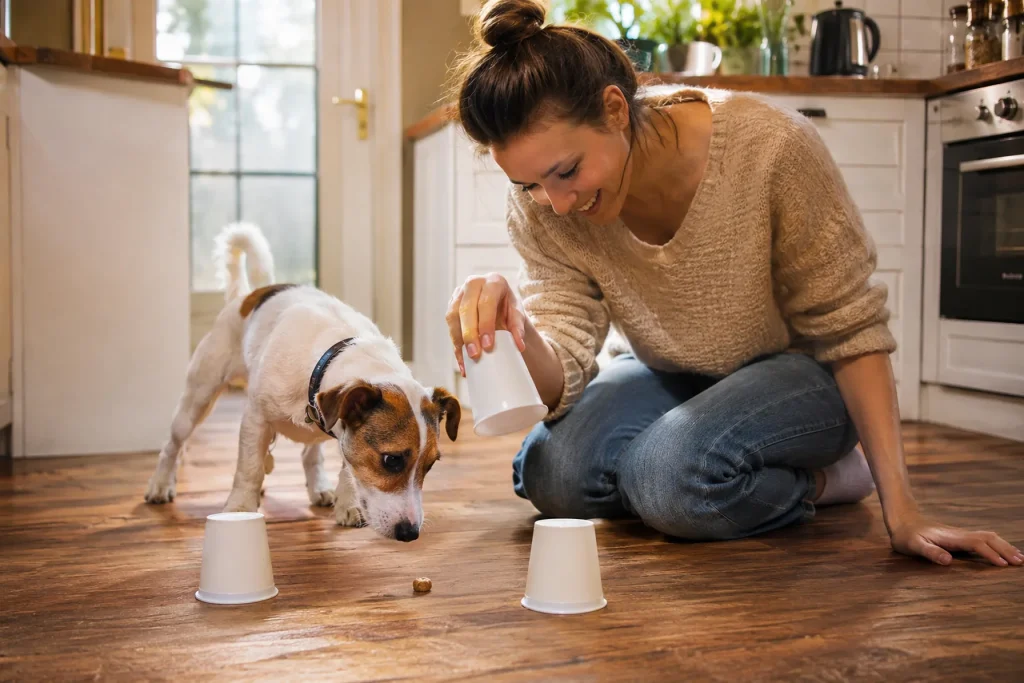
Hide a treat under one of several upturned boxes or plastic tubs and let your dog find it. Move the treat each round. Start with holes poked in the tops so the smell gets out, then bait fewer boxes and spread them out.
Towel Snuffle Knot
Scatter kibble on a tea towel, roll it up and tie it in a loose knot. Your dog noses it open to reach the food.
Scent Trail
Lay a short trail of small treats that ends at a favorite toy. Make the trail longer and add turns as your dog gets better. A few minutes is enough.
Hide and Seek
Ask your dog to sit and stay, go to another room and call your dog’s name once. Celebrate when your dog finds you. Start with easy hiding spots. This game also builds a reliable recall.
Sit in the Middle of Play
Get your dog excited with a toy, then ask for a sit in the middle of the game and reward it straight away. Go back to playing as the reward. This teaches self-control when your dog is excited.
Mini Obstacle Course
Use cushions to step over, a broom handle laid across two books to hop, and chair legs to weave around. Keep jumps very low, and skip them for puppies and dogs with back or knee problems.
How to Rotate and Store Toys
Dogs lose interest in toys that are always on the floor. Rotating them makes old toys feel new again.
- Pick three or four toys for the week: one chew, one puzzle, one soft toy and one ball.
- Put the rest away in a closed box or bin, out of sight.
- Swap the set every week or so.
- Leave one favorite comfort toy out all the time if your dog sleeps with it. Our guide to small dog beds helps you set up a cozy sleeping spot.
The toy your dog likes best is usually the one you play with together. A few minutes of tug or fetch with you does more than a pile of toys on the floor.
For storage, a lidded bin or a basket that is easy to wipe out works well. Keep washed food toys separate so they dry fully between uses.
When to Clean or Throw Away a Toy
Toys collect saliva, dirt and bacteria, and soft toys can grow yeast and fungi. Wash the toys you keep regularly and throw away the ones that are worn out.
- Wash food toys after every use, before leftover food goes bad.
- Scrub rubber toys in hot, soapy water, rinse well and let them dry fully.
- Check the label before putting a toy in the dishwasher or washing machine.
- Throw a toy away when stuffing shows, rope frays, rubber cracks or a squeaker is exposed.
- Replace a durable chew before it wears thin or gets sharp edges.
There is no fixed schedule for replacing toys. Check every toy once a week and replace it as soon as it fails one of these checks.
Small Dog Toys: Frequently Asked Questions
What do vets recommend for aggressive chewers?
Vets usually recommend durable rubber toys that still bend and dent with a fingernail, not very hard chews. Bones, antlers, cow hooves and hard nylon chews can break teeth. Choose a size that cannot fit fully in your dog’s mouth, watch your dog chew, and replace the toy before it wears thin. Ask your vet to check your dog’s teeth at each visit.
What is the most durable type of toy for a small dog?
Solid, one-piece rubber is the most durable choice for most small dogs. It holds up better than plush, rope or thin plastic and does not shed fibers or small pieces. Durable does not mean indestructible, so check the toy often. If your dog can bite chunks off it, switch to a different toy.
What should I give a dog that destroys every toy?
Give a dog that destroys toys a mix of tough rubber chews, stuffed food toys and daily sniffing games, and rotate a few toys instead of leaving many out. Destructive chewing is often boredom or pent-up energy, so more play and mental work usually helps. If it happens mainly when your dog is alone, talk to your vet or a qualified trainer.
Are tennis balls safe for small dogs like Shih Tzus?
Standard tennis balls are not ideal for small dogs like Shih Tzus. They are often too big to carry comfortably, and the felt is abrasive enough to wear down teeth with heavy chewing. A mini dog ball or a smooth rubber ball that is still too big to swallow is a safer choice. Use balls for fetch, not as chew toys.
Are squeaky toys safe for small dogs?
Squeaky toys are safe for most small dogs if you supervise play and check the toy often. The risk is the squeaker: once a dog opens the toy, the squeaker can be swallowed or choked on. Take the toy away as soon as a seam splits, and choose rubber toys instead for dogs that shred plush.
What size toy is safest for a small dog?
The safest toy is too big to fit completely inside your dog’s mouth but small enough for your dog to carry. For balls, pick one your dog can carry but cannot swallow. When in doubt, go one size up. Toys sold as extra small can still be too small for a dog that chews hard, so check each one against your own dog.
How often should I wash my dog’s toys?
Wash food-dispensing toys after every use and wash other toys regularly, because toys can carry bacteria, yeast and fungi. Scrub rubber toys in hot, soapy water and let them dry fully. Follow the label before machine washing plush toys. Throw away any toy that is too worn to clean properly.
How often should I replace dog toys?
Replace a dog toy as soon as it is damaged, not on a fixed schedule. Throw it away when stuffing shows, rope frays, rubber cracks or a chew wears thin or sharp, because loose pieces can be swallowed. Check every toy once a week. Strong chewers will go through toys faster than gentle players, so check their chews more often.
What is the best way to store dog toys?
A lidded bin or an open basket that is easy to wipe clean is the best way to store dog toys. Keep most toys out of sight and rotate three or four each week so they stay interesting. Store food toys separately, and only once they are washed and fully dry.
Do dogs need toys?
Yes. Toys give dogs a safe outlet for chewing, chasing and problem-solving, which are natural behaviors. Without them, many small dogs chew furniture or bark from boredom. A few well-chosen toys plus daily play with you is enough. Your dog does not need a big collection, just the right types for the way it plays.
Ready to choose? Start with one tough chew, one puzzle toy and one soft toy, then add more only if your dog uses them. For breed-specific activity and care needs, browse our small dog breed directory. Browse more small dog gear guides.